Women's soccer training techniques
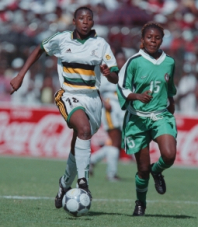
Women's soccer is the fastest growing segment in
sports.
In North America alone it supercedes all other national sports
in increases to membership per year, and shear volume of participants.
The ball got rolling in 1994 with the World Cup being held in the USA and the Women's World Cup in
1999 saw an explosion of the sport all over the world not only in North America.
Most interesting to note is that the traditional Football (soccer) powerhouses around the world are
not well represented or dominant in the world of Women's soccer.
Technical Aspects
Technical aspects of the sport have grown faster because of
the lessons learn from the past. This is to say that Women's soccer did not start from square one but was able to
use all the latest training methods available. Whatever was working was quicky absorbed into women's soccer
arena.
As the newest and latest training methodology is so readily available, the improvements made in women's soccer are
very impressive. You can find an enormous amount of information today that wasn't readily available 20 years
ago.
We can all thank the internet for the massive volume of
materials being put forth. Communication is the key to your success, and finding what works for you is the key.
One of the keys to your success will be in
training female athletes.
Social Aspects
The social aspects of women's sports differ from men's, and soccer is no exception.
Female athletes require social time right before a practice or
a game. If you listen to the differences in topics between
male and female athletes before a game you will generally find that females are less focused on the opposing team
and more focused on their own team. This can also include their personal lives that they have to contend with.
Males are sizing up the competition and posturing for individual performance first. Females are
usually concerned with internal team dynamics and then will focus on the competition.
The atmosphere of camaraderie on the day's events is important for the development of the social
fabric of the team.
Males require less "talk-time", and as a result can fall into the practice or game a little
quicker. If you remember this then
the women's and girls' practice sessions will go smoother.
Don't fight it, or control it, accept it. Your team will grow stronger and you will be a better person for it.
Remember these are generalizations, and don't apply to every situation. They also apply less to highly competitive
athletes.
Mental Aspects
At game time both male and female athletes will have their
heads into the game.
The routes to get there however will have been different,
with females athletes feeling more like compatriots and less
like combatants as the males do.
This has all been as a result of the socialization process that each gender has endured since
birth.This process may explain why there are lower rates of fouls and infractions during the women's games than the
men's games.
Self doubt and lower self esteem in females results in lower
levels of play and activity. However, while observing males,
these issues are combated by harder tackles and more physical play. It appears that emotional control would be at
opposite
ends of the spectrum when dealing with levels of performance
at game time.
As a direct result, attentional control is affected by the lack
of, or over compensation in performance.
The female athletes take it out on themselves, they internalize and focus inward, while the males take it out on
their
opponents. Males will then display more displaced aggression
as a result. All of these athletes and players need help with
re-focusing the attentional and emotional aspects of the
game. A soccer coach will need to know each one of the players to find the right combination of triggers to enhance
the players emotional state. This is done while employing different cues and techniques for the genders.
This uniqueness to the different approaches makes it understandable for the different genders. Learning to
communicate more effectively becomes a powerful tool in
the development of a team.
Physical Aspects
Females have been programmed to view themselves as a
specific body type. This is specifically true in the Western
World where fashion and beauty stereotypes are upheld to
a certain standard.
Sports and soccer in general are changing these views,
globally, with an emphasis on strength, agility and power
taking the driver's seat.
Beauty is ballet on the grass,... with a soccer ball of course.
Their creativity and imagination is awesome...let them
perform
Women's health has started to revolve around more activity
and nutritional habits, rather than the limitations of diet
control as being the only option.
The rapid rise of women participating in soccer and sports
in general has left some unanswered questions.
Why is there a higher rate of knee injuries in women over men? The percentage of these injuries is so much higher
that there seem to be two major components that revolve around these issues. Anatomical and mechanical realities
are not being addressed, nor is the corrective training methodology
associated with these issues are being place forward.
There are still too many male training methodologies use when coaching women and youth.
Soccer needs to be more phase and gender specific.
There are on going studies that will divulge some answers.
OUR awareness will come from examining better overall fitness and training methods.
Check out the latest of news on women's soccer with:
W-League
Women's FA
Continue to grow and explore the unique ways to coach female athletes.
For links to help you with this go to
Womens Soccer Links.
| 